The most consequential decision Robert Kolker made in “Bad Art Friend” was telling it out of order.
Kolker’s version appears to be chronological, but he withholds crucial information until the third act. As a result, the internet has spent days debating who the titular B.A.F. of the story is.
Because I have a big project due this week, I spent those days in a procrastinatory frenzy, reading as many Dorland v. Larson legal documents as I could get my hands on. From my perspective, telling the story in linear time makes it far easier to take sides.
2005-2015: Kinda-Sorta Friends
Sonya and Dawn met in either 2005 or 2007, depending on which pdf you believe. They both lived in Boston at the time, ran in the same literary circles and were involved with a writing nonprofit called GrubStreet.
The nature of their friendship is one of the core elements of the ongoing legal case. Dorland claims they were close, sharing intimate conversations and spending significant time together. Larson claims that they were not. According to her lawyer, they have never been alone in a room together.
One of the most fascinating aspects of Bad Art Friend is the degree to which it acts as a Rorschach test. Chances are, you identify with one of the protagonists early in the story, then find yourself excusing their increasingly indefensible behavior. Cards on the table: At this point in the story, I’m with Dawn. I have always feared that my behavior is cringey in ways that I’m unaware of and that my friends discuss behind my back. This anxiety is particularly acute in professional settings, where I often don’t know the “rules” for social interaction and how to draw the line between my LinkedIn self and my actual personality.
My factual interpretation of these early years is that Dawn liked Sonya and thought they had a real connection. Sonya found Dawn obnoxious but didn’t want to make a Thing out of it because they inhabited the same small professional scene. My moral interpretation is that when someone you dislike considers you a close friend, that is a form of power. You don’t have to like them back, but you’re still obligated to treat them with a baseline of respect — even if they’ll let you get away with less.
Fast-forward to July 2015. Dawn has been away from Boston for four years. She keeps up with the old scene on social media but doesn’t have any direct contact with Sonya. She gives away her kidney to a stranger and sets up a Facebook group to update her close friends on the process. Dawn says this group contains 20-30 people, Sonya says it includes 250-300 and a screenshot in the legal filings (from years after it’s set up) shows it with 68 members.
This is where Dawn lost lot of readers in Kolker’s story. Setting up a Facebook group to (basically) brag about the good thing you did is bad enough. Dawn then wrote to Sonya to ask why she hadn’t engaged with any of the posts. According to Dawn, Facebook analytics showed that Sonya had seen them, but hadn’t liked or commented. Kolker also includes a brutal aside: During this time Dawn attended a writers’ conference where she bumped into numerous members of the Facebook group, few of whom brought up her charitable act.
“I left that conference with this question,” she tells Kolker, “Do writers not care about my kidney donation?”
I’m not going to defend Dawn exactly, but I’ll be honest about my emotional reaction to her. All of this is objectively cringe, but it’s also deeply human. Most people are smug and self-congratulatory after they volunteer at a soup kitchen or study abroad. It’s clear that Dawn gave away her kidney partly because she wanted other people to praise her. So what? She saved someone else’s life at moderate risk to her own health. Personally, I think that gives her a license to be obnoxious on social media for a few months afterwards.
Reaching out to Sonya to ask why she hadn’t liked any of her posts makes slightly more sense if you recall that Dawn considered her a close friend and saw the Facebook group as a small, private forum. This wasn’t a place where Dawn was posting public appeals for her friends to donate to charity or “Hey look I’m on the Jumbotron!” self-aggrandizement. She was doing that on her public Facebook page.
The private group was where she posted information about medical complications and more intimate dispatches — one of which was the text of the letter she sent to the end recipient of her “kidney chain.” To my knowledge, she never posted this letter anywhere publicly.
I honestly find all of this a bit baffling because it would never cross my mind to set up a private Facebook group, but I can easily imagine someone who, say, just had a baby wanting a forum to talk about their postpartum depression with a few close friends. Given the size of the group and Dawn’s expectations, it’s understandable that she would notice that one of the friends she invited into her confidence had viewed all of her posts but hadn’t responded or checked in on her.
I still think e-mailing Sonya to ask why she hadn’t engaged is fairly obnoxious, but in Dawn’s mind this was a close friend who was passively participating in a supportive forum yet wasn’t offering support. The pinned post on the Facebook group stated clearly that this was a place for Dawn’s close friends to track updates and read her private reflections. If that’s not your thing, the post said, feel free to leave at any time.
I couldn’t find her message to Sonya in the legal filings, but from later correspondence it seems she was doing a temperature-check. Is this something you’re interested in? Maybe you don’t have time right now or you think I made a rash decision. Rather than take the out, Sonya doubled down. She reiterated her friendship with Dawn, her support for the donation and her interest in staying in the group.
As for the writer’s conference, Dawn’s quote feels more sad than entitled to me. From her perspective, she had undergone a major surgery and was embarking on a new philanthropic project that was taking up a lot of her time. And yet her close friends, people she had entrusted with this information before she even got the surgery, didn’t seem like it was worth remarking on. Dawn even spotted Sonya at the writer’s conference but got the impression she was avoiding eye contact.
Again, imagine someone who just had a baby or got their master’s degree. It’s not unreasonable for them to expect their close friends to make some sort of comment about it.
I’m not going to defend Dawn’s general smugness nor condemn Sonya for disliking her. It really does seem like Dawn concocted a close friendship out of almost nothing, something she was probably doing with other members of their social circle too. That’s irritating behavior. But it’s nowhere near as immoral as what Sonya was about to do.
2015: Ctrl+C, Ctrl+V
So here’s where we stick with the timeline, in contrast to Kolker’s NYT story. According to later legal filings, Sonya began working on a short story based on Dawn’s kidney donation at almost exactly the time Dawn reached out to her: Summer of 2015.
“The Kindest,” she says in a filing, “is a fictional short story about an alcoholic, working class, Chinese-American woman who receives a kidney donated by a wealthy white woman.”
Around a third of a the way through the story, Sonya’s protagonist receives a letter from the “white savior” who donated her kidney. In the original version of the story, the one Sonya submitted to numerous publishers and recorded for Audible, this letter is almost identical to a letter Dawn posted on the private Facebook group.
Despite what Sonya will later tell her friends to make Dawn seem unreasonable, this wasn’t an honest mistake or written from memory or placeholder text that was left by accident. Sonya made only superficial tweaks to the text of Dawn’s letter. And she knew it: Months later she texted two friends, “I think I’m DONE with the kidney story but I feel nervous about sending it out b/c it literally has sentences that I verbatim grabbed from Dawn’s letter on FB. I’ve tried to change it but I can’t seem to — that letter was just too damn good.”
Now everything clicks into place. Sonya stayed in Dawn’s Facebook group, at least in part, to surveil and mock her. The legal filings include numerous exchanges where Sonya’s friends text her with some variation on “you’ll never guess what Dawn posted this time” and Sonya responds in turn.
Sonya’s short story was based on Dawn; an early draft even called the white-savior character “Dawn.” Everyone who knew them both and read the story knew exactly what was going on.
I don’t know whether this is illegal, but it is straightforwardly unethical behavior as a writer and immoral behavior as a human.
Sonya could have quietly unfollowed Dawn or refused to participate in the Burn Book group chats. She could have written a story where her contempt for Dawn was better-disguised, swapping out kidney donation for adopting kids from Ethiopia or running a marathon. She could have been honest with Dawn when she checked in: Look, I know you think we’re friends but we’ve grown apart since you left Boston and it’s probably best if we just move on.
Instead, she wrote the story, sent it off, went through the editing process and got it published — all while lying to Dawn’s face about the nature of their relationship. And, bafflingly, without bothering to change the text she lifted from Dawn’s letter.
2016-2018: Confrontation
Now we come back to Kolker’s timeline. A year later, in the summer of 2016, Dawn’s friend (in the snitch-tag of the decade) left a comment on her Facebook page saying that Sonya had just done a reading of a short story featuring a kidney donation.
Dawn was hurt. Her friend hadn’t seemed interested in her own story of donating a kidney. And now she wrote one without saying anything to her?
Dawn reached out to Sonya to say she had heard about the story and asked if she could read it. Sonya said it wasn’t finished and denied that it had anything to do with Dawn’s experience or the Facebook group. Dawn’s donation was a jumping off point, but it was only the seed of a story that had grown in a different direction.
Kolker saves this for his third-act twist, but Sonya was lying. Not only was the story finished, it had already been published. She was working with an actor to record an audio version. Behind the scenes, Sonya updated the text of the letter to make it look less identical to Dawn’s and e-mailed Audible to ask them to re-record that part of the story.
In their e-mail exchange — in which Dawn comes off as needy and Sonya comes off as icy — the two had come to a truce and ended by reiterating their commitment to remaining friends. Dawn had no reason to disbelieve Sonya about the “The Kindest” having nothing to do with her, so she seems to have let it drop. She didn’t even read it: The story came out in 2017 but Dawn ignored it, either because she expected it would stress her out or because she didn’t want to pay for a copy, depending on whether you believe her legal filings or her interview with Kolker.
Then, roughly a year after their e-mail exchange, “The Kindest” was published without a paywall on the website of American Short Fiction. A month or so after that, Dawn decided to finally read it.
She was shocked. While Sonya had updated the wording of the letter significantly since the original version, Dawn immediately recognized the structure and tone of her own.
There were also some lingering similarities. Dawn’s letter, for example, had said, “I focused the majority of my mental energy on imagining and celebrating you.” [she underlined this part on Facebook]. Sonya’s fictional letter said “I found a profound sense of purpose, knowing that your life depended on my gift.” [also underlined in the printed text]. Perhaps most damningly, Sonya’s fictional white savior ends her letter with “Kindly,” Dawn’s standard e-mail sign-off.
Dawn was livid. And here’s where my sympathies start to shift.
2018: Lawyers Get Involved
It was clear to Dawn that Sonya had written a story about an entitled, oblivious, self-aggrandizing kidney donor based on her own life and lifted from her Facebook posts. Over the following months, Dawn attempted to scorch the earth underneath Sonya’s writing career.
First she reached out to American Short Fiction to tell them that Sonya’s story included passages plagiarized from her own work. The tone of these letters is, frankly, obnoxious. Dawn threatens legal action and suggests that ASF give her space for an essay to accompany Sonya’s story.
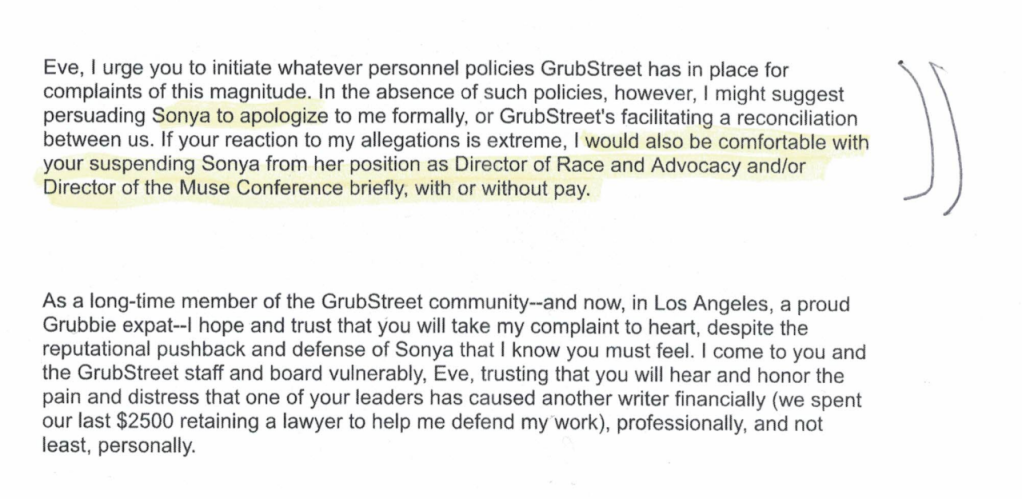
Dawn was marching into Stalingrad. She filed a copyright on her original letter, hired a lawyer and pitched the story to journalists. She reached out to more than a dozen mutual acquaintances and literary institutions. Dawn claims that some of these letters were just to inquire about their plagiarism policies, but the legal filings also include requests to remove Sonya from her position at literary organizations.
A month after ASF published the story online, Dawn learned that it was slated to be included in One City One Story, an anthology published by the Boston Book Festival. (In one of many darkly funny asides in the legal filings, Dawn only learns this in advance because Sonya puts it on her personal website before the festival announces it. Writers!).
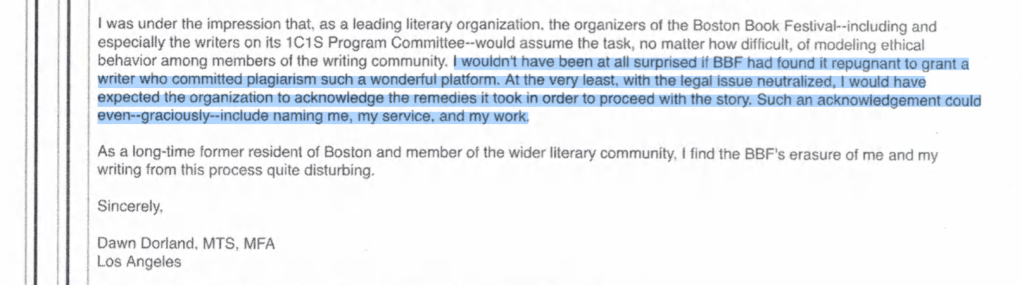
Again Dawn put on her viking helmet, tasking her lawyer to send a cease and desist notice and threatening the festival with $150,000 in damages. Her correspondence with the festival organizers is also dripping with condescension.
Here we are again at straightforwardly unethical and immoral behavior. Local book festivals do not have deep pockets. According to correspondence included in the legal filings, the festival organizers spent more than $10,000 defending themselves. Whenever they tried to meet Dawn’s demands, she ratcheted them up. In the end, they canceled the festival and destroyed every copy of the anthology.
I should note, however, that there’s some blame for Sonya here too. As the festival organizers point out (in some of the saltiest e-mails I’ve ever seen), she never should have submitted a story that was part of a copyright dispute with another author. She knew Dawn was going after the ASF and, let’s remember, that Dawn’s claim was correct. She had based her character on Dawn and her letter on Dawn’s letter.
Considering that they knew a lot of the same people and worked with the same literary organizations, did she really think Dawn was just never going to find out? I keep marveling at how little Sonya seemed to consider Dawn’s feelings or the possibility of a copyright claim during the two-plus years she spent writing and revising this story.
2018-Present: Let’s Go To Court
It’s not clear to me who formally hired a lawyer first, but Sonya sued first, filing a claim against Dawn for “tortious interference” — sabotaging her financial relationships with publishers, writers’ workshops and, it appears, the entire American literary establishment. Dawn had stumbled across the original version of the story, the one with the super copy-pasted version of her letter, online and countersued for copyright infringement and emotional distress.
I have no idea whether any of Dawn’s or Sonya’s actions constitute legally actionable behavior and I don’t care. Bad Art Friend is a morality play — that’s what makes it so interesting to talk about — and the legal system is only relevant as a weapon wielded by one protagonist against the other.
This is, as far as I can tell, how Dawn and Sonya have spent the last three years, suing and countersuing each other. Over 7,000 pages of discovery evidence have now been entered into the record. The original lawsuits have become numbingly boring meta-lawsuits about whose counsel said what and which plaintiff owes discovery evidence to the other. Even I, a procrastination Olympian, could not muster up the gumption to untangle or give a shit about these technicalities.
The only thing I’m sure of is that by now, both women have spent tens of thousands of dollars fighting in court about a short story that sold for $425. They have also, as of this weekend, achieved the worst kind of fame, the kind where people on the internet boil your entire life down to your most regrettable relationship and argue about whether you are a bad person or a terrible one.
So here I am, a person on the internet, delivering my verdict. From where I sit, identifying the Bad Art Friend is easy. In the early years, it is Sonya. She abused Dawn’s trust to mock and gaslight her, while lying to their mutual friends to make her look even worse.
In the later years, it is Dawn. Someone you considered a friend turned your intimate reflections into a derogatory short story and humiliated you in front of your social circle. That sucks, but turning your hurt feelings into a career vendetta and a years-long legal battle is sucky behavior too. Dawn’s letters to Sonya’s publishers acknowledge that this mattered to her primarily as an emotional betrayal by a friend, not a professional transgression by a fellow writer. She could have written a gossipy Medium post or a retaliatory short story or started a spicy group chat. But to me, cutting her losses and walking away was (and is) the most graceful option.
I have no idea how the rest of this story is going to play out. It is probably not worth a New York Times feature and absolutely not worth the weekend I have spent reading blurry screenshots in PACER pdfs. Whatever happens, I sincerely hope that they both keep it off of Facebook.
For decades, policymakers and linguists were convinced that Black English (once called “Ebonics” and now sometimes known as African-American Vernacular English), was a formless, arbitrary form of slang incapable of expressing complex thought or intelligent reasoning. “It is said,” Labov tells us, “that [Black children] cannot speak complete sentences, do not know the names of common objects, cannot form concepts or convey logical thoughts.”
This was, of course, simply a statement of bias. Starting in the 1960s, linguists began to map the features of Black English and identified consistent structures, rules and grammar. They may have differed from those of Standard English, but they were just as capable of conveying information.
The problem, looking back, was not that Black English speakers were unintelligent. It’s that (mostly white) listeners could not separate the form of speech from its content. Take this interview with “Larry,” a 15-year-old Black kid interviewed by one of Labov’s colleagues.
LARRY: Some people say if you’re good an’ shit, your spirit goin’ to heaven… and if you bad, your spirit goin’ to hell. Well, bullshit! Your spirit goin’ to hell anyway, good or bad.
Q: Why?
LARRY: Why? I’ll tell you why. Cause you see, doesn’t nobody really know that it’s a God, y’know. ’cause, I mean I have seen black gods, pink gods, white gods, all color gods. And don’t nobody know it’s really a God. And when they be sayin’ if you good, you goin’ to heaven, that’s bullshit. ‘Cause you ain’t goin’ to no heaven, ’cause it ain’t no heaven for you to go to.
As Labov points out, Larry’s speech includes all of the hallmarks of Black English: Double negatives (“don’t nobody”), invariant conjugation (“they be sayin'”) and something called “optional copula deletion” (“if you’re good…if you bad”). Non-AAVE speakers are conditioned to see these features as “broken English” — and thus markers of lack of intelligence — but each appears in numerous foreign languages and doesn’t, by itself, convey information any less efficiently than Standard English.
But Larry’s speech also contains the hallmarks of complex reasoning. His argument is that the core precept of many religions — good people are rewarded in the afterlife and bad people are punished — is impossible to determine because everyone has their own definition of ‘good’ and ‘bad.’ If no one can prove that God exists, how could we determine that he created a heaven for us to go to? That’s pretty smart for a 15-year old!
The reason this wasn’t obvious to most white listeners at the time was that their preconceptions about how Larry speaks made them incapable of hearing what he was saying. They simply couldn’t fathom that “broken English” could express a sophisticated concept.
The same concept — I’m finally getting to the point of this post, I promise — also works in reverse. Labov then quotes a middle-class, college educated adult named “Charles.”
Q: Do you know of anything that someone can do, to have someone who has passed on visit him in a dream?
CHARLES: Well, I even heard my parents say that there is such a thing as something in dreams, some things like that, and sometimes dreams do come true. I have personally never had a dream come true. I’ve never dreamt that somebody was dying and they actually died, or that I was going to have ten dollars the next day and somehow I got ten dollars in my pocket.
I don’t particularly believe in that, I don’t think it’s true. I do feel, though, that there is such a thing as witchcraft. I do feel that in certain cultures there is such a thing as witchcraft, or some sort of science of witchcraft; I don’t think that it’s just a matter of believing hard enough that there is such a thing as witchcraft. I do believe that there is such a thing that a person can put himself in a state of mind, or that something could be given them to intoxicate them in a certain frame of mind that could actually be considered witchcraft.
This is gibberish. Charles is arguing that some people believe dreams can predict the future, but since it’s never happened to him it can’t be true. He then, somewhat nonsensically, changes the subject and says that people may be able to put themselves in a mind-state where they can perform witchcraft. He doesn’t, however, specify what that actually means.
The vast majority of listeners would perceive Charles as more intelligent than Larry. Charles’ speech adheres to all the rules of Standard English. It contains no profanity and pads itself out with words and phrases (“intoxicate them in a certain frame of mind”) that indicate a large vocabulary. The markers of intelligence make it easy for listeners to convince themselves that Charles must be saying something smart — even when he isn’t.
All of this brings us to the debate over Joe Biden’s withdrawal from Afghanistan. Over the last week I’ve become increasingly frustrated at the number of articles that insist on casting the Taliban takeover of Kabul as an episode in a political drama, an event whose primary importance is the role it will play in the midterm elections … in 15 months.
“If the virus continues to worsen or the situation in Afghanistan deteriorates further,” said the New York Times on Sunday, “many of the president’s allies fear he will lose the confidence of the moderate swing voters who lifted his party to victory in 2020.”
The story, like many others in this genre, doesn’t attempt to determine whether Biden’s decision was correct. It is simply a collection of quotes from strategists and Democratic political figures speculating about how this week’s events will be perceived by voters. A Hawaiian House Rep worries about the “optics” of the pullout. A Republican pollster warns of frustration among unnamed Democrats. A North Carolina state senator says Afghanistan “has entered the conversation in a big way.”
The story ends with a Democratic National Committee member telling the authors, “The reality is, you break it, you buy it. President Biden has this pandemic in his hands and regardless of the cause of disinformation, he gets to own that.”
I want to be very clear about the argument I am making: This. Is. Not. Smart.
Every quote in the New York Times story reads like the air-fried nothingburger of the Charles excerpt from Labov’s article. They seem intelligent, but what are they actually saying? It reflects badly on presidents when their foreign policy decisions generate grisly news footage? Ummm, yes. Afghanistan has become a more salient issue for voters in the last few days? No duh.
The DNC member’s kicker quote boils down to “voters blame presidents for things that happen during their administrations even when they’re not directly responsible.” Did we really need a political insider to tell us that?
The true Shakespeare of this form of hollow punditry is political scientist and professional Persuader Yascha Mounk. On August 17, Mounk published an Atlantic article arguing that pulling out of Afghanistan wasn’t a mistake due to the human suffering it will cause, but because it will embolden Donald Trump’s brand of populism. Creating chaos in Kabul, Mounk says, only reinforces the Trumpist critique of out-of-control government waste and incompetence.
Let me now struggle to fully convey just how not-smart this fucking article is.
First, Mounk never provides any evidence for his central claim. He notes that most Americans support withdrawing from Afghanistan and that pulling out will allow Biden to focus on domestic problems. “The U.S. presence in the country did not serve any significant economic interests,” Mounk says.
Sounds like a pretty good argument to leave!
But not so fast. Withdrawing from Afghanistan, Mounk says in the next paragraph, “fails to meet its intended purpose. Designed to weaken the hands of populists like Donald Trump, it will only make their resurgence more likely.”
And then… nothing. He changes the subject. Later he returns to the issue of public polling and says:
So: Americans like Biden and don’t like the war in Afghanistan. But once they find out how bad things are, they’ll change their minds.
This is not evidence. Usually when people predict the future they at least attempt to support their view. The Yankees are going to lose tonight because they don’t play as well when it’s raining. Clinton is going to win because gas prices are down. Something! The only pieces of evidence Mounk presents for his assertion are a) we’re likely to see violent videos come out of Kabul over the next few months and b) this could inspire another terror attack in the U.S.
Again: Not evidence. You can’t support a prediction about the future with more predictions about the future!
Take a look at the paragraph where Mounk lays out this argument.
This is Charles personified. Mounk displays all the markers of intelligent speech (“could grow even more potent”), but the actual argument here is both asinine and incorrect. America might not have another terror attack. Mounk claims that voters will turn on Biden if we have another 9/11-style attack, but let’s rewind to what happened to George W. Bush’s approval rating after, um, a 9/11-style attack.
Speaking from a cynical, amoral, polls-uber-alles perspective (which Mounk absolutely is), Biden should be rooting fora terrorist attack. If you’re gonna do punditry, at least do it well.
The second central dumbness of Mounk’s column stems from three words: “Fairly or not.”
So far, attacks on Biden as incompetent have lacked punch outside the right-wing media echo chamber; voters had little reason to think that he was unable to lead the country. But the videos now emanating from Afghanistan give a visceral visual to a line of attack that is sure to ramp up in the coming months. Fairly or not, they connect Republicans’ preferred characterization of Biden with a real-world catastrophe he oversaw.
This is another nonsensical argument. The basic premise here is that Biden’s Afghanistan pullout was wrong because it will invite Republican criticism — regardless of whether that criticism is accurate.
Mounk clearly does not realize this, but he is delivering an argument against Democratic presidents doing literally anything. Don’t raise taxes on the rich, Republicans will say you’re hurting the middle class. Don’t support clean energy, Republicans will say you’re impoverishing coal miners. Don’t fund infrastructure, Republicans will say you’re tearing down bridges.
This is not a standard of morality we apply in any other field of human behavior. If you, I dunno, raise the pay of all the interns at work and your boss criticizes you for lowering productivity even though productivity increased, most of us would say your boss is being an asshole. When someone lies about someone else, we typically blame the liar rather than the person they’re lying about.
I could go on. Mounk never grapples with any of the events that led to Biden’s decision, nor how the stunning incompetence of America’s occupation could also reinforce a narrative about government ineffectiveness. While criticizing the human toll of pulling out of Afghanistan, he ignores the human toll of staying. He says Donald Trump wanted the U.S. out of Afghanistan, then notes in a parenthetical that he did not, as president, actually do this.
Reading this column teaches you nothing whatsoever about Afghanistan or America. If its predictions turn out to be false, its analysis is incorrect. If they turn out to be true, it is redundant. Either way, there is no reason to revisit this kind of journalism in a year’s or even a week’s time. It is, to get proverbial on you, the intellectual equivalent of the raccoon and the cotton candy.
But this isn’t about Yascha Mounk or his shitty article or the Afghanistan pullout. It is about what Jay Rosen calls the “cult of savviness.” Over the last 30 years, journalists have convinced themselves — and their readers — that this above-it-all form of political analysis is an expression of intelligence. Instead of getting into the messy minutiae of whether it was right to pull out of Afghanistan, these pundits want to explore whether it was strategic. What are the “optics” of the withdrawal? What narratives will it reinforce? And most importantly, always and forever, HOW WILL IT AFFECT THE MIDTERMS?
I am here to tell you that it is not smart. It is easy and it is lazy and it is just as sophisticated as bullshitting with your friends at a bar about the best Marvel movie (Guardians of the Galaxy 2) or whether pineapples should go on pizza (they should not). It requires no intellectual effort.
Rosen has a great anecdote about a journalist who spent years looking into the Flint water crisis. When pressed on the question “who’s responsible?” he prevaricates, resorting to punditry about “it depends on which team you’re on,” and “it’s impossible to separate truth from spin.”
What strikes me about those answers is that anyone could have given them. Declaring “each party has their own narrative about Flint” doesn’t require any knowledge about the crisis or even deep knowledge about U.S. politics. It is the journalistic equivalent of reading the back cover of a book and then pretending you read it. Similarly, pontificating about the political impact of Flint doesn’t require so much as opening a Wikipedia entry. All you have to know is what politicians are saying about the crisis — the easiest possible information to gather.
It’s telling that Mounk’s Afghanistan take doesn’t include any interviews with experts or links to Afghanistan-specific research. It demonstrates no understanding of the country or the reasons the American occupation failed. But why would it? It’s the past that’s messy and complicated and requires intellectual engagement to understand and explain. Predicting the future just requires a few CNN articles and a glance at cable news. “Optics,” after all, is just another way of saying how things look. No need to get bogged down in how things are.
And this is what I want to end with: All of the questions savvy punditry puts aside — the impacts of policies, the context of events, the accuracy of a politician’s line of attack — are the core functions of journalism. They require effort and knowledge and time. They are why we are here, why this is a job.
Skipping them doesn’t make you smart. It makes you Charles.
“You can be a hot mess express and still leave the world better than you found it.”
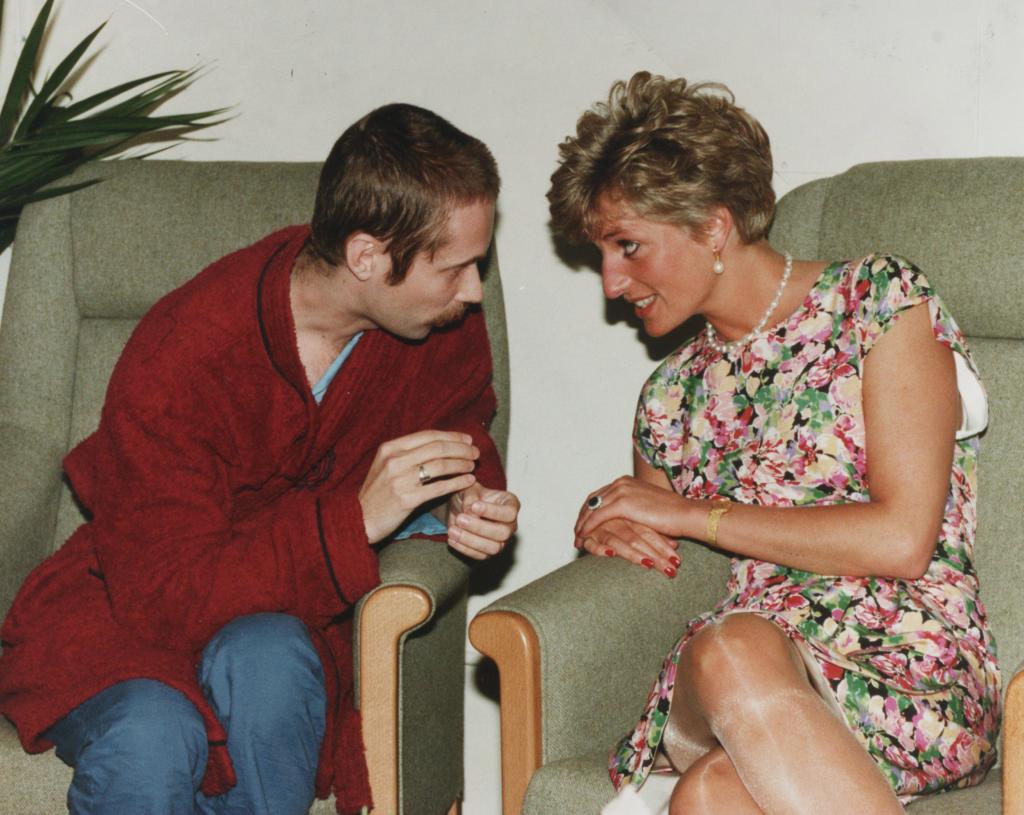
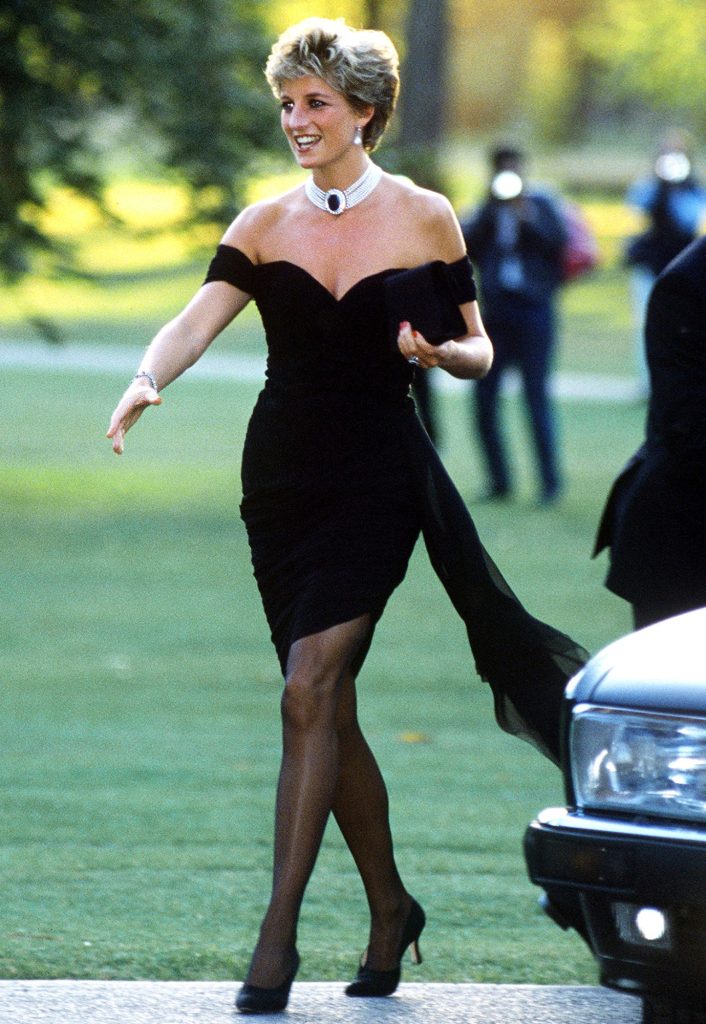
In the final episode of our series, we talk about Diana’s untimely death and the everlasting conspiracy theories surrounding it. Digressions include RPGs, Madonna and Tickle Me Elmo. This episode contains spoilers for the movie “The Queen.”
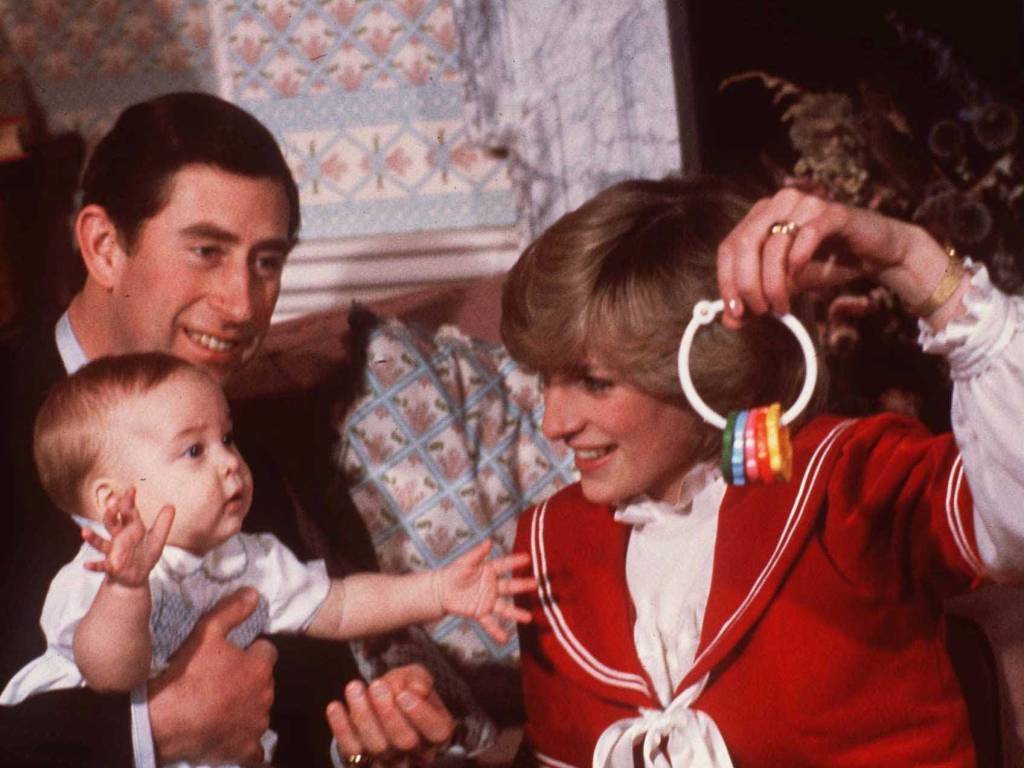
This week, Diana leaves the royal family with her reputation intact and her title slightly edited. Digressions include “Love Actually,” “Pride and Prejudice” and Marie Antoinette. Both co-hosts reveal their staunch affirmative stance on wine moms.
This week, Diana swaps out her husband for a Horse Dude and Mike and Sarah act out other people’s PG-13 dirty talk. Digressions include shoulder pads, Billy Joel and “Seinfeld” (twice!). There’s a moment 55 minutes in that is going to make you feel very weird. As with previous installments, this episode contains detailed descriptions of disordered eating.
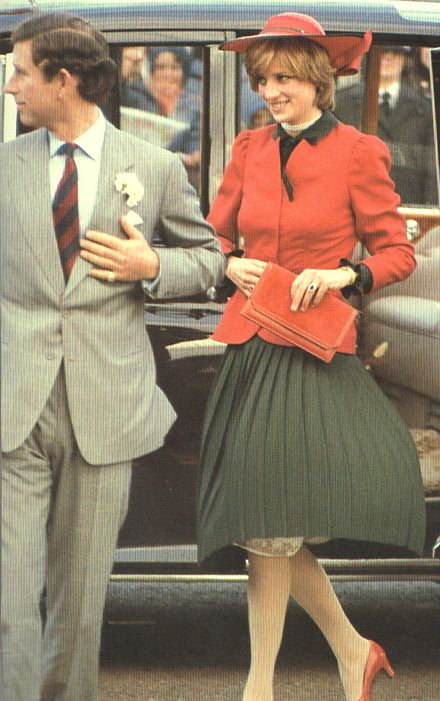
This week, Diana gets married, joins her new family and meets the press. Digressions include Judy Garland, Edward Cullen and the AITA subreddit. Unfortunately, this episode includes detailed descriptions of suicide attempts and eating disorders.
We start our new series with the story of a girl, a prince and the society that convinced them they liked each other. Digressions include camels, Beyoncé and the idiosyncrasies of British place names. We’re sorry to say that this episode has detailed descriptions of disordered eating.
“Her parents’ financial success is dependent on her abdomen.” This week, Jessica moves to L.A., records a video and meets a boy. The celebrity cameos escalate. Digressions include overalls, werewolves and Judy Garland. This episode unfortunately contains detailed descriptions of disordered eating.
Our journey through late-’90s pop stardom begins with an intervention and ends with an audition. Digressions include Willie Nelson, Ozzy Osbourne, Jane Fonda and the cast of the Mickey Mouse Club. Sarah’s English degree and exercise habits make appearances. This episode, we’re sorry to say, contains descriptions of sexual abuse.
Mike tells Sarah how an obscure technical glitch became a nationwide mobilization. Digressions include Twitter beefs, “The Net” and VHS pricing. We spend much of the episode roasting our own work from the relatively recent past.
CORRECTION: It seems the women in Britain didn’t terminate their pregnancies due to the false positive test results. We were wrong about this and we’re sorry!
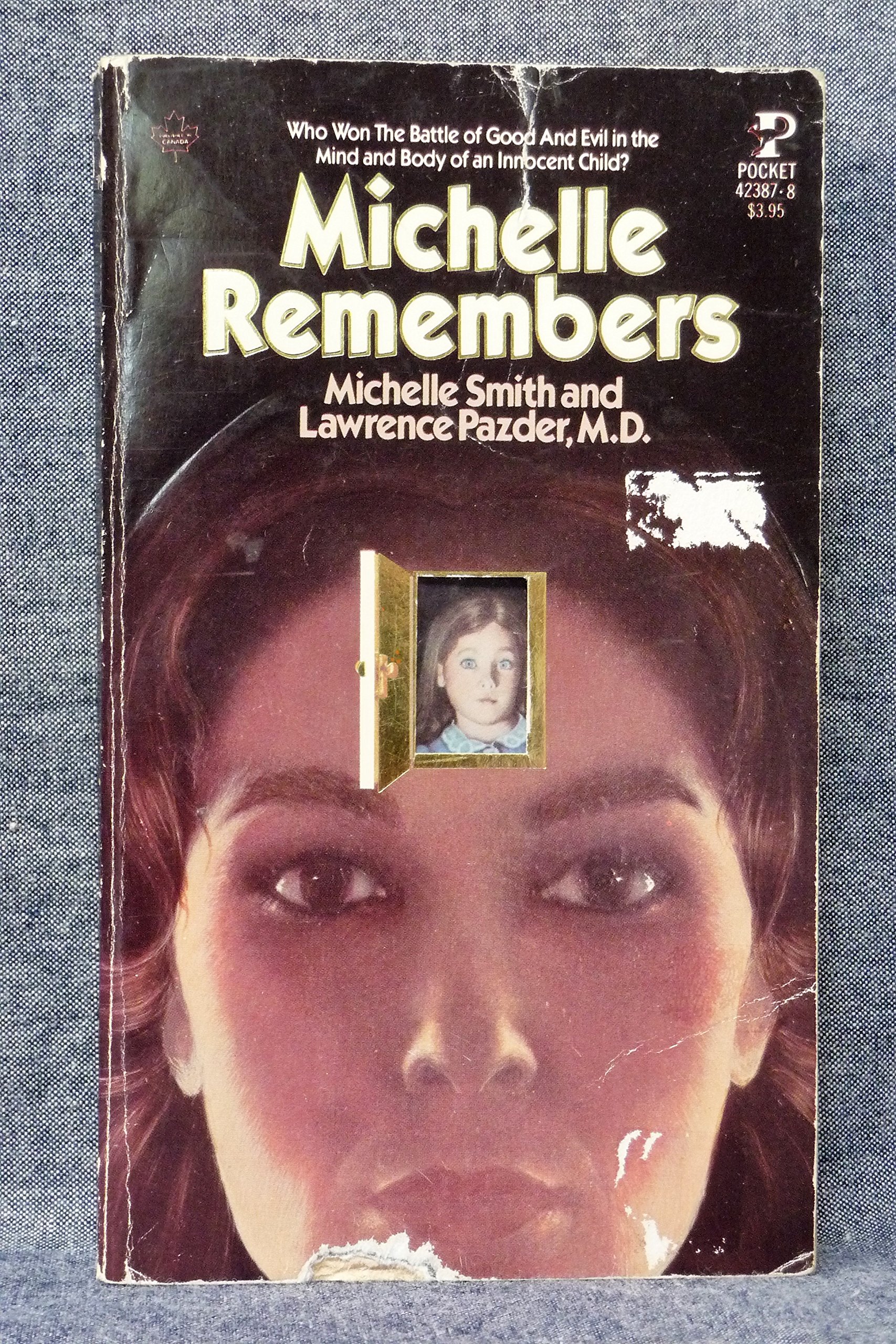
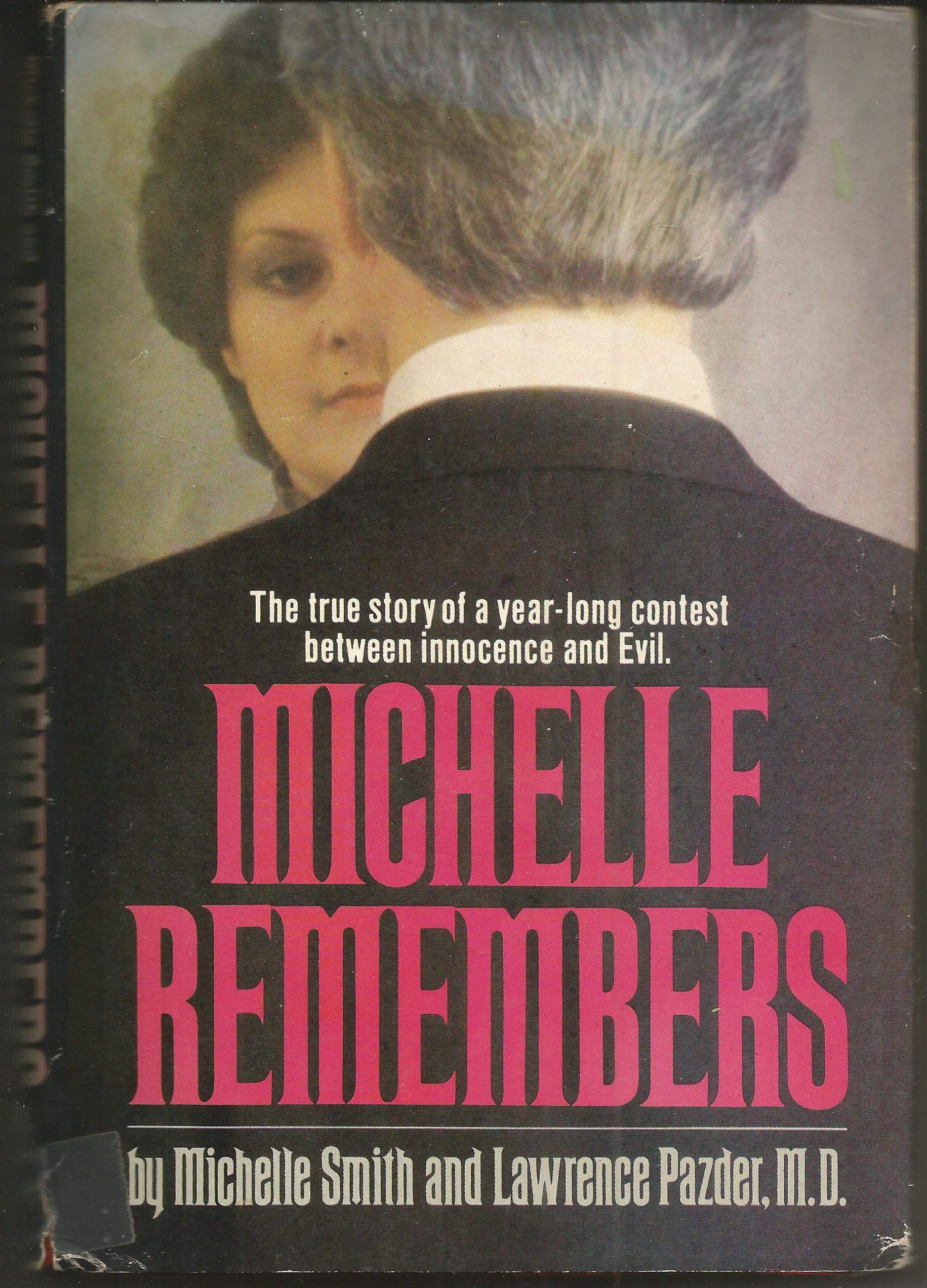
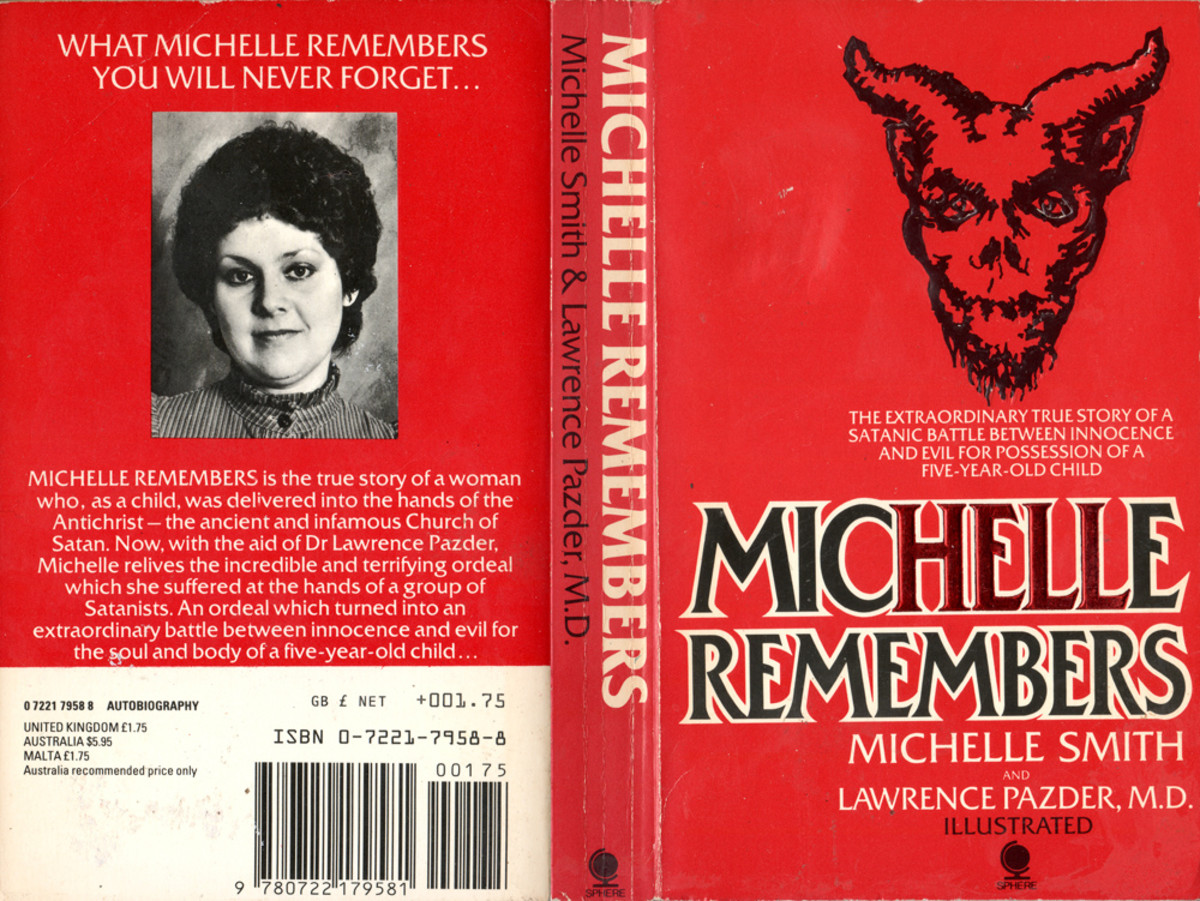
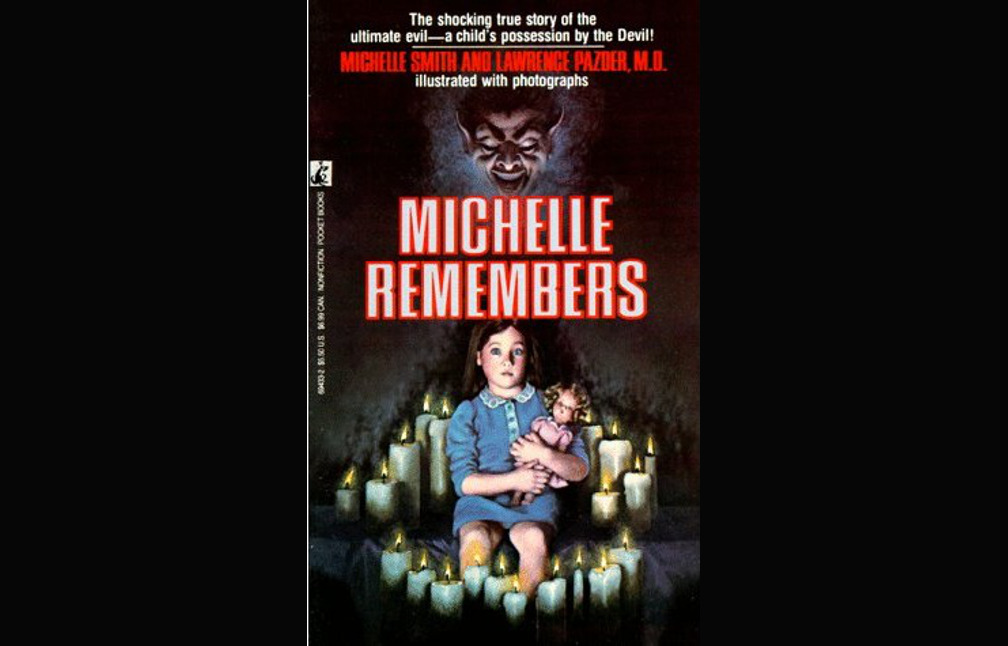
We conclude our book club with Michelle’s escape from the dungeon. The dead baby trend continues; Jesus, the Virgin Mary and Satan’s fingernails make brief appearances. Digressions include Dustin Hoffman, “Total Eclipse of the Heart” and things that rhyme with Beelzebub. This episode contains references to child abuse and sexual assault.
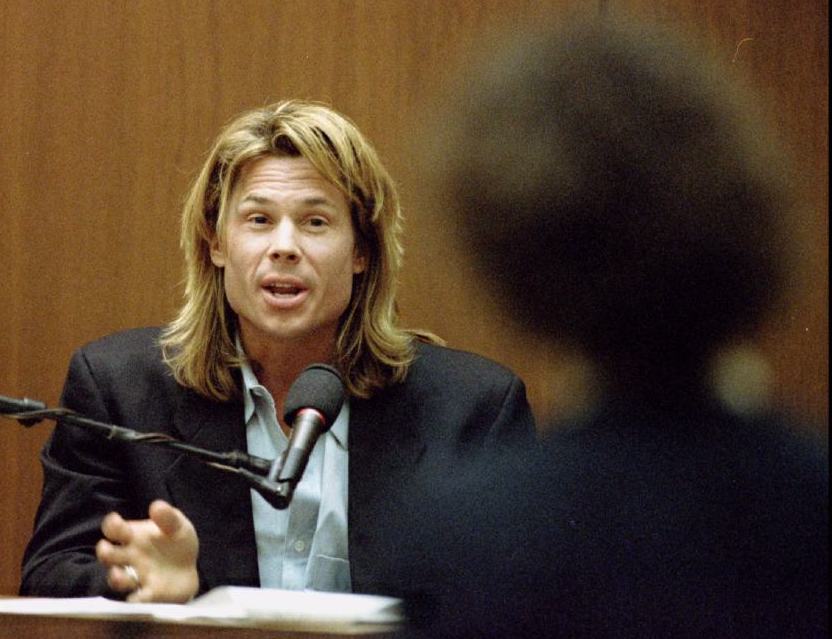
Sarah tells Mike about the clash of the titans, the fury at the grand jury. We follow Kato, the wise fool of the kingdom, for the week between the murders and the Bronco chase. Digressions include John Travolta, French kickboxing movies and “The Mummy.” The celebrity cameos are less numerous than usual but no less absurd.
This week, our lithe psychiatrist takes his favorite patient hiking, a priest burns some furniture and Michelle tries to escape her remembering. This episode contains descriptions of kitten sacrifice, sexual abuse and three more dead babies.
Sarah and Mike continue into the depths. With Dr. Pazder home from Mexico, he and Michelle journey into her subconscious and the stories they find there continue to get weirder. This episode contains kitten sacrifice and the first—but not the last—dead baby of the Satanic panic.
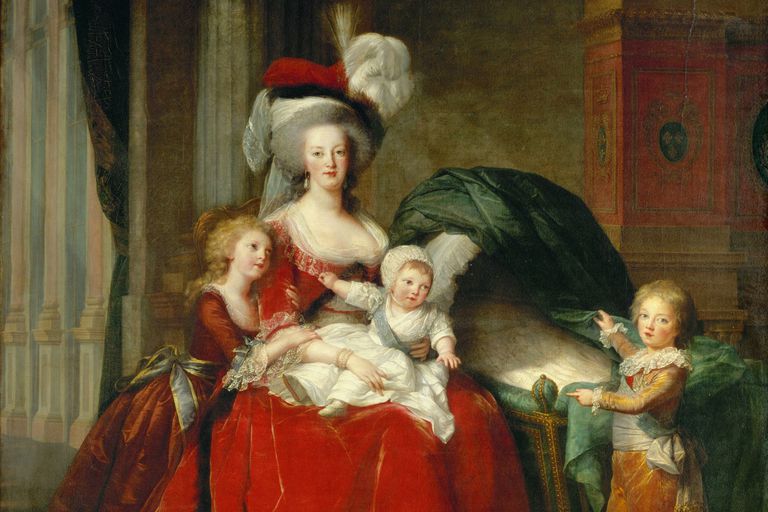
“What’s sad about her has nothing to do with the content of her character.” Special guest Dana Schwartz tells Mike and Sarah how an Austrian princess became a French scapegoat. Digressions include Rubik’s Cubes, Taylor Swift and Tom Stoppard. The use of the word “bawdy” exceeds all previous episodes combined.
Sarah and Mike continue their journey into the book that launched a thousand lawsuits. Michelle and Dr. Pazder’s relationship grows more troubling by the chapter. Digressions include orgy etiquette, sheepskin jackets and “Indiana Jones and the Temple of Doom.” Neither co-host believes anything depicted in this book happened as described, but still want to warn you that it contains scenes of torture and sexual abuse.
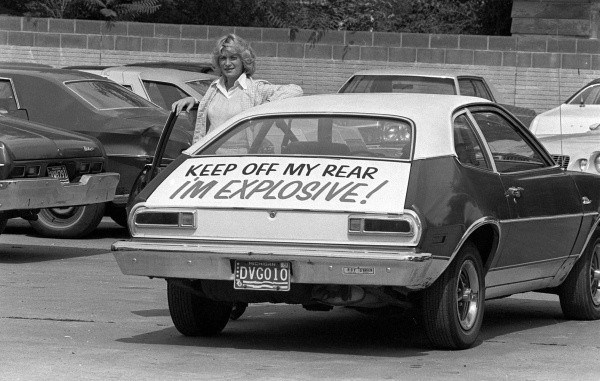
Mike tells Sarah about a dying industry, a dangerous car and the acclaimed article that misrepresented them both. Digressions include “Mission Impossible,” “Friday the 13th” and the naming conventions of academic articles. This episode contains a larger-than-usual number of dad jokes and a shocking revelation about Johnny Carson.
Sarah describes the spark that ignited the Satanic Panic. Our setting is a therapist’s office in 1976 Victoria, B.C., and our digressions include Sybil, scary paperbacks from the ’80s and shouting “Fire!” in a crowded theater. This episode describes child abuse.














 Rottin' in Denmark